


Patient-centric research is our passion
In today’s healthcare landscape, the patient voice has become an indispensable component of real-world research. By incorporating patient insights, including their preferences, studies can be designed to better reflect their lived experiences, making protocols and interventions more practical and less burdensome. This focus on patient-centered outcomes ensures that research prioritizes what matters most to patients, such as quality of life and day-to-day functionality. Moreover, engaging patients in the research process fosters trust and collaboration, creating a stronger connection between researchers and the communities they aim to serve.
At Pulse Infoframe, we have pioneered an evidence generation platform that places patients at the heart of the research process, recognizing that their experiences and perspectives are crucial for developing truly effective healthcare solutions. By integrating patient-reported outcome measures (PROMs) and fostering a culture of patient engagement in our registries, we ensure that research not only focuses on clinical metrics but also captures a more holistic view of the patient experience, addressing aspects of health that matter most to patients, such as quality of life, symptom management, and emotional well-being.
Our approach goes beyond traditional data collection methods, actively engaging patients throughout the entire research journey. By empowering patients to play an active role in shaping the future of drug development, our approach bridges the gap between research and patients’ lived experiences to ensure solutions are impactful and equitable.
Our commitment
Our commitment to amplifying the patient voice goes beyond mere data collection; it’s about fostering a supportive community where patients feel truly heard and valued—especially within rare disease communities that are often overlooked.
To achieve this, we embrace continuous, iterative platform enhancements that may seem minor but significantly reduce the burden on patients and caregivers. Many of these improvements were guided by invaluable feedback from patient families.
One of the most impactful early changes was the introduction of an auto-save feature for survey responses. For families affected by CDKL5, where frequent seizures demand immediate attention from a parent or caregiver, interruptions during survey completion often resulted in lost progress if the “save” button was not clicked. By implementing auto-save, we not only streamlined the data entry process for parents and caregivers but also increased overall engagement with the platform.
Because CDKL5 is a rare condition, the patient population is small and geographically dispersed. To reach as many patients as possible, our team prioritized continuously adding new languages to the registry, ensuring it remains inclusive and accessible. By making the registry available in 10 languages, we enrolled participants from 47 countries. 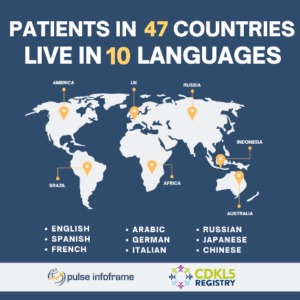
This registry, among others, also employs a decentralized model, allowing patients to enroll online from home without needing to travel to a participating site. People living with CDD face significant challenges, such as limited mobility, geographic isolation, and lack of access to specialized medical centers. Remote enrollment addresses the logistical barriers of travel, enabling participation from the comfort of their homes and making it more feasible for patients to contribute.
Providing multilingual and remote options demonstrates respect for patient autonomy and ensures that research initiatives do not inadvertently exclude certain populations. Moreover, larger and more diverse patient populations can accelerate clinical trial recruitment, yield better insights into disease patterns, and support the development of therapies tailored to various demographics. By removing geographic, linguistic, and logistical barriers, rare disease registries can maximize participation, enhance data quality, and contribute to improved treatments and outcomes for these underserved populations.
CDKL5 registry successes
We pioneered a comprehensive registry design process that goes beyond traditional approaches, collaborating closely with patient advocacy organizations and key opinion leaders (KOLs) to create a truly patient-centric platform. This collaborative blueprint not only enhances the quality and relevance of the collected data but also fosters a supportive ecosystem where patients, and our patient advocacy group partners, felt valued and empowered. Ongoing success cannot be taken for granted, it requires nurturing and communication to address proposed improvements to the patient experience and relevant metrics for researchers.
- In depth interviews with patient caregivers and clinicians to ensure we capture the most critical and relevant data points without overburdening patient families
- Leaned into the ecosystem by participating in and speaking at CDKL5 conferences in Japan, Italy and the US.
- Provided education and guidance to enable advocacy partners to present registry data
- Enabled a phased global expansion of the registry, scaling from 1 to 10 languages with participation from 47 countries
- Developed and implemented a method to link data from other studies, allowing the registry to serve as a comprehensive data repository
- Met with family groups in Italy and Japan and participated in all CDKL5 forums globally, while presenting at some conferences to illustrate the value of the registry for patients
- Knowledge dissemination through posters and presentations
Key Research Questions Shaping the Future of CDKL5 Drug Development
Every data collection effort involves carefully evaluating trade-offs between the scientific research questions it can address and the burden on those entering data. The CDKL5 Registry was designed for a specific purpose of providing a baseline understanding of the natural history of disease, quality of life (both patient and caregiver), lifetime cost of treatment, social impact of treatment and disease progression.
As the drug development landscape in this condition has evolved in recent years, including the FDA acceptance of ZTALMY to treat seizures associated with CDKL5, there are now new questions that drug developers looking to differentiate their asset will want to answer.
- How does the standard of care and treatment choice for CDKL5 differ across various countries, and what are the implications for patient outcomes?
- What is the proposed seizure-related efficacy of new CDKL5 therapies compared to existing standards of care?
- How will we compare long-term safety and efficacy outcomes of emerging CDKL5 treatments compare to currently available therapies?
- What impact do CDKL5 therapies have on non-seizure-related developmental milestones compared to standard treatments?
- How cost-effective and affordable are new CDKL5 treatments for healthcare systems?
- How do we incorporate patient preferences into the data collection framework so we understand what is important to families?
- Is Newborn screening available in various Countries? How can CDKL5 be added to NBS panels in the future?
As the CDKL5 treatment landscape continues to evolve, addressing these critical research questions will help pharma companies develop therapies that not only improve patient outcomes but also demonstrate long-term value and accessibility. Strategic data collection and analysis are essential to answering these questions and driving innovation in CDKL5 treatment.
Our continued commitment to fill evidence gaps
At Pulse Infoframe, we are deeply dedicated to advancing support for the CDKL5 community and committed to addressing these questions and evidence gaps that surround this rare neurological disorder. In addition to the questions outlined in the previous section, evidence gaps persist in areas such as the clinical course of patients, disease presentation, age specific challenges patients face, molecular pathways, genotype-phenotype correlation and much more.
Through our state-of-the-art platform and close collaboration with patients, caregivers, and researchers, we strive to foster meaningful, patient-centered research. This unified approach strengthens our understanding of the condition’s natural history and paves the way for the development of targeted treatments and improved care strategies.